Showing posts with label volcano. Show all posts

Thursday, December 15, 2011

Mt. Halla in Jeju

Mt. Halla, Mt. Hanla or Hallasan in Jeju is the highest mountain in South Korea. You can't realize that the mountain is high because it's not tiring to climb it. It's like a walking course with fantastic view. You don't feel bored or get tired of climbing because walking on a plain road is more than climbing. I'm talking about this.


Ther's a bridge near the entrance. I think it's awesome in rainy days.


Before the bridge are these stairs. I was surprised! My hubby asked if we came to climb up the mountain or climb down. Isn't it strange? hehe..


You can't believe that this course is on top of the mountain.


Here's Sajebidongsan. You can view this when you reach the top as shown above.


Of course there are rocks. As you know, Jeju Island is a volcanic island, dominated by Halla-san (Halla Mountain); a volcano 1,950 metres (6,400 ft) high.


Spring from the mountain where hikers and climbers stopped to obey their thirst. Even if you aren't thirsty, you should try it. It's cool, fresh and it has different taste from normal water. A tourist took out a big bottle from his backpack and put some water in it. He said he wanted to get some and sell in the mainland. That sounds like a good business. hehehe..


Here's the Manse Park Observatory. There are telescopes use to view the different kinds of oreum (walking or climbing course). You don't need to insert coins to view the other mountains so feel free to use them.


On the left side of Manse Park Observatory, you can view Mangcheoreum (Chetmangoreum): It was named for the Oreum U-shaped crater resembling mangche meaning a U-shaped coarse sieve. Also, the Bulgeunoreum with the meaning of reddish for "bulgeun", the area was named for the blood covered mountain from the suicidal end of the fight by Gen. Kim Tong-jeong and his wife, his soldiers and their wives at the time of the Sambyeolcho (Three Elite Patrols) Rebellion, a korean rebellion against the Goryeo Dynasty that happened at the last stage of the Mongol invasions of Korea.


And on the right side are "Minoreum" meaning a flat headed hill. "Janggumokoreum" which was named for the narrowing ridge that leads to Janggumokoreum and Samgakbong like the bridge of Janggu, an hourglass drum. "Wangsokbat"; wangsok means a large stone and bat means field. "Hallasanjubong" (crater wall). "Witseoreum", it is the common name for all 3 oruems of Bulgeunoreum, Nuweunoreum, and Jogeunoreum
at the highest place of the area. And "Manseidongsan hill" or Mansudongsan hill or Mangdongsan hill; the name came from this high landscape used to be a lookout point to watch over the grazing cattle and horses.


View from the other sides of Manse Park Observatory.


The trees on Mt. Halla. They look beautiful specially in winter.


There are some benches where you can stop and rest when you're tired climbing.


There are lots of birds at the parking lot. Hallasan is really a place where you can enjoy the nature.


Btw, there are buses going to Mt. Halla so you don't need to have your own car to visit the mountain. Check out the time of arrival and departure of buses so you can plan your visit to Hallasan.


Thursday, November 3, 2011

Seongsan Ilchulbong

The Ilchulbong is a tuffcone formed about five thousand years ago by an eruption in shallow sea. The tuffcone was an island shortly after the eruption but became smaller after thousands of years of wave erosion. The eroted materials were transported southwestward and deposited along the eastern shore of Jeju Island. The tuffcone became eventually connected with the main island, resulting in the present coastal landscape.


The vertical and spiral-shaped pillar of rocks surround the climbing path of Seongsan Ilchulbong Tuff Cone. In the time of hydrovolcanic activities which created this tuff cone, the pyroclastic (ash) deposits of the tuff cone margins had steeply inclined near the crater rim and piled up. Raindrops on the deposits forced a flow down the slope, and the deposits eroded over time, that creating a land that appears deeper than the ground itself.

It says that the legendary spirit dwells in Deung-Gyung Stone so please refrain from any acts that interfere with the viewing. People in the village of Seongsan Deunggyeongdol (Limp Rock) or Jinggyeongdol. Villagers have a custom of bowing four times when passing by. In olden days villagers had ancestral rites and prayed for prosperity of the village and for families to live in peace.


There is a huge crater at the top of Seongsan Ilchulbong Peak. The crater is about 600m in diameter and 90m high.


They said that the sunrise from the crater is magnificent so we climbed up early morning to watch the sunrise but we weren't lucky enough because it rained the night before we came. We only saw this.


Here's the view from the peak of Ilchulbong.


The view of Uido Island from Ilchubong.


The ridge provides an ideal spot for walks and for horse riding as well.


It was still dark when we climbed up Ilchulbong to see the sunrise but as I said we weren't lucky enough.


Tuesday, October 25, 2011

Sangumburi

There are over 360 parasitic volcanoes on Jeju Island most of which have no craters. Those that do have craters shaped like upturned bowls or horseshoes. However Sangumburi Crater which was formed by an explosion without the ejection of lava or volcanic ash has one single hole known as the Marr crater. It is the rarest type in Korea and indeed the world.


Sangumburi Crater was designated as Natural Monument No. 263, the reason being that the plants growing inside the crater have been isolated even from the plants in Mt. Halla. Because of this phenomenon, they have become valuable resources for studying the geographical distribution of plants. Add this from the priceless value of the crater itself for geological study and you can see why Sangumburi crater is so unique.

Sangumburi is located in Gyorae-ri, Jocheon-eup, Jeju City 400 meters above sea level with an exterior circumference of 2,067m and an interior circumference of 756m. Its height is 438m, its depth 132m and it is 300,000m².About 450 species of plants grow in Sangumburi. On the exterior sides of the volcano are pampus grass colonies, producing a spectacular fall display. The interior slope of the crater shows a wide range of vegetation with seasonal variations depending on the amount of sunlight.


Sangumburi crater is regarded as having a high academic value because of the well preserved Ligustrum ovalifolium community, Orixa japonica community, Adonis multiflora community and Eranthis byunsanensis community which are rarely found anywhere else.

The crater is also well-known as a habitat for various wild animals ranging mammals including roe deers and badgers, to birds and reptiles.

The gate.


The beautiful that you can also enjoy while walking with loveone, family or friends.


You know that you are in Sangumburi if you see this cones or bell shapes outside.


Wednesday, July 6, 2011

Mt. Songaksan

Unlike other volcanoes, Mt. Songaksan is unusual in that it has numerous peaks and parasitic cones. The main cone rises 104m above sea level. The crater is 500m in circumference and 80m deep and still contains dark-red volcanic ash. The northwest side of the main cone is covered with a lush field of grass, and two parasitic cones can be seen there. There are several man-made caves along the coastal cliff that had been built by the Japanese army during the Japanese occupation, reminding the Koreans to this day of the tragedy of the Japanese invasion of Korea.


This military facility was built by the Japanese for suicide attacks using small ships against the fleet of the allied forces when they faced defeat in the Pacific War. It comprises 17 caves along the coastal cliffs of Mt. Songaksan on the southeastern side of Jeju, in linear, H-shape, or open-ended square formation. Built into the cliffs by the forced labor of Jeju residents, this facility not only speaks vividly of Japanese invasion but also demonstrates the cruelties of war in which soldiers are forced to die.


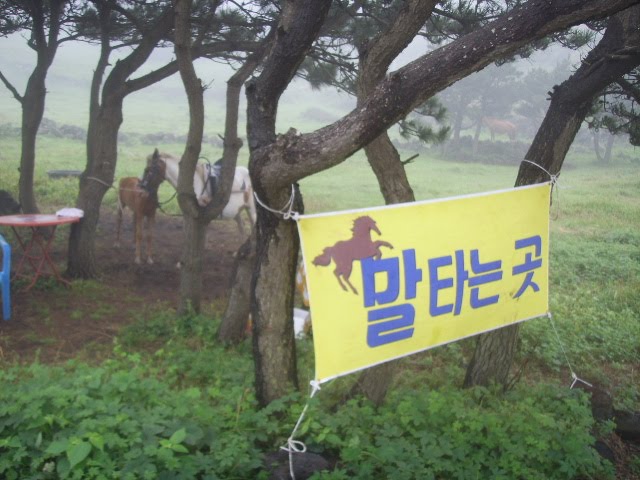
Kids can enjoy the horse-riding.


You can climb up using the stairs from the sea.


You can't only enjoy taking a walk on a wonderful view but also do some exercise using machines.


The water is so clear that you can view some sea creatures even when you're above the volcano.


View while taking a walk.


It's hard to imagine that the water can reach on top of the mountain.


The famous drama Daejanggeum "Jewel of Palace" was filmed here.