Showing posts with label mountain. Show all posts

Thursday, December 15, 2011

Mt. Halla in Jeju

Mt. Halla, Mt. Hanla or Hallasan in Jeju is the highest mountain in South Korea. You can't realize that the mountain is high because it's not tiring to climb it. It's like a walking course with fantastic view. You don't feel bored or get tired of climbing because walking on a plain road is more than climbing. I'm talking about this.


Ther's a bridge near the entrance. I think it's awesome in rainy days.


Before the bridge are these stairs. I was surprised! My hubby asked if we came to climb up the mountain or climb down. Isn't it strange? hehe..


You can't believe that this course is on top of the mountain.


Here's Sajebidongsan. You can view this when you reach the top as shown above.


Of course there are rocks. As you know, Jeju Island is a volcanic island, dominated by Halla-san (Halla Mountain); a volcano 1,950 metres (6,400 ft) high.


Spring from the mountain where hikers and climbers stopped to obey their thirst. Even if you aren't thirsty, you should try it. It's cool, fresh and it has different taste from normal water. A tourist took out a big bottle from his backpack and put some water in it. He said he wanted to get some and sell in the mainland. That sounds like a good business. hehehe..


Here's the Manse Park Observatory. There are telescopes use to view the different kinds of oreum (walking or climbing course). You don't need to insert coins to view the other mountains so feel free to use them.


On the left side of Manse Park Observatory, you can view Mangcheoreum (Chetmangoreum): It was named for the Oreum U-shaped crater resembling mangche meaning a U-shaped coarse sieve. Also, the Bulgeunoreum with the meaning of reddish for "bulgeun", the area was named for the blood covered mountain from the suicidal end of the fight by Gen. Kim Tong-jeong and his wife, his soldiers and their wives at the time of the Sambyeolcho (Three Elite Patrols) Rebellion, a korean rebellion against the Goryeo Dynasty that happened at the last stage of the Mongol invasions of Korea.


And on the right side are "Minoreum" meaning a flat headed hill. "Janggumokoreum" which was named for the narrowing ridge that leads to Janggumokoreum and Samgakbong like the bridge of Janggu, an hourglass drum. "Wangsokbat"; wangsok means a large stone and bat means field. "Hallasanjubong" (crater wall). "Witseoreum", it is the common name for all 3 oruems of Bulgeunoreum, Nuweunoreum, and Jogeunoreum
at the highest place of the area. And "Manseidongsan hill" or Mansudongsan hill or Mangdongsan hill; the name came from this high landscape used to be a lookout point to watch over the grazing cattle and horses.


View from the other sides of Manse Park Observatory.


The trees on Mt. Halla. They look beautiful specially in winter.


There are some benches where you can stop and rest when you're tired climbing.


There are lots of birds at the parking lot. Hallasan is really a place where you can enjoy the nature.


Btw, there are buses going to Mt. Halla so you don't need to have your own car to visit the mountain. Check out the time of arrival and departure of buses so you can plan your visit to Hallasan.


Wednesday, July 6, 2011

Mt. Songaksan

Unlike other volcanoes, Mt. Songaksan is unusual in that it has numerous peaks and parasitic cones. The main cone rises 104m above sea level. The crater is 500m in circumference and 80m deep and still contains dark-red volcanic ash. The northwest side of the main cone is covered with a lush field of grass, and two parasitic cones can be seen there. There are several man-made caves along the coastal cliff that had been built by the Japanese army during the Japanese occupation, reminding the Koreans to this day of the tragedy of the Japanese invasion of Korea.


This military facility was built by the Japanese for suicide attacks using small ships against the fleet of the allied forces when they faced defeat in the Pacific War. It comprises 17 caves along the coastal cliffs of Mt. Songaksan on the southeastern side of Jeju, in linear, H-shape, or open-ended square formation. Built into the cliffs by the forced labor of Jeju residents, this facility not only speaks vividly of Japanese invasion but also demonstrates the cruelties of war in which soldiers are forced to die.


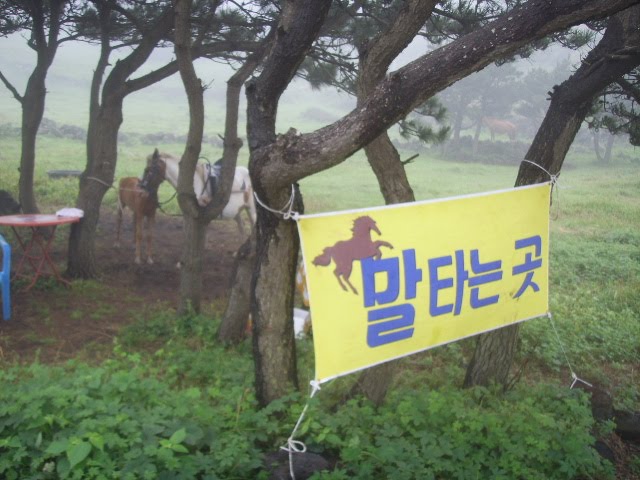
Kids can enjoy the horse-riding.


You can climb up using the stairs from the sea.


You can't only enjoy taking a walk on a wonderful view but also do some exercise using machines.


The water is so clear that you can view some sea creatures even when you're above the volcano.


View while taking a walk.


It's hard to imagine that the water can reach on top of the mountain.


The famous drama Daejanggeum "Jewel of Palace" was filmed here.


Sunday, June 12, 2011

Jeoji Oreum

Joji Oreum or Parasitic Volcano has one of the most beautiful forest in Jeju. It measures 390m in height and 1540 meters in width. Jeju Olle Route 13 spread along this Jeoji Oreum - its top and circumference. "Jeoji" is a name of the village in Jeju and "Oreum" means climbing.

You will never get tired because it's cool and it has beautiful sightseeings. You will enjoy every steps of your walk. There are lots of trees and there are even lots of raspberries that you can pick and eat while taking a walk. It's just a small mountain and it's not steep so you won't get much tired.


View while taking a walk.


Jeoji Oreum is a famous place for taking a walk, climbing, exercising, and traveling because you'll see the beauty of Jeju when you're on top of the parasitic volcano. Here's the view from the top.


After reaching the top, it's time to go down to see the crate of the volcano. It's the steepest of the volcano but you'll love it. It's also the most tiring area when you climb up the stairs.


Here's the crate.


This is the area at the entrance of Jeoji Oreum. So, you can take a rest here or exercise with the machine before or after climbing up.


Thursday, March 25, 2010

Mt. Mudeung

In Korea, over 70% of the land is mountainous with the eastern regions consisting of mainly rugged mountain ranges and deep valleys. It's not surprising if there are many people enjoy hiking in the foothills and mountains.
One of the most famous mountains that I've climbed was the Mt. Mudeung with 1,186.8 meters high. Located at Iseo-myeon, Hwasun-eup, Hwasun-gun; Dong-gu and Buk-gu in Gwangju; and Nam-myeon in Damyang-gun. Mt. Mudeung has plenty of tourist attractions. The mountain is not sharp to climb so don't be surprise even if you meet the crowd who want to enjoy its scenic beauty on weekend. Most of them usually go up in casual wear.

Would you believe that there's also playground on top of the mountain? This is on top of the mountain and the whole family are now enjoying the nature and beauty of Mt. Mudeung.

You can also take a walk with this flat area on top. There are some benches to relax when you're tired. Or you can sit down and see the wonderful view.

Here's what you can see from the benches.


No need to worry if got thirsty from climbing up the high mountain because there's spring that can obey your thirst. It's cool and taste good. Some are carrying big gallons and get much water from it because they believe that it's good for our health.

There are also resthouses on top of the mountain which is always full of tourists eating and drinking soju (korean alcohol).